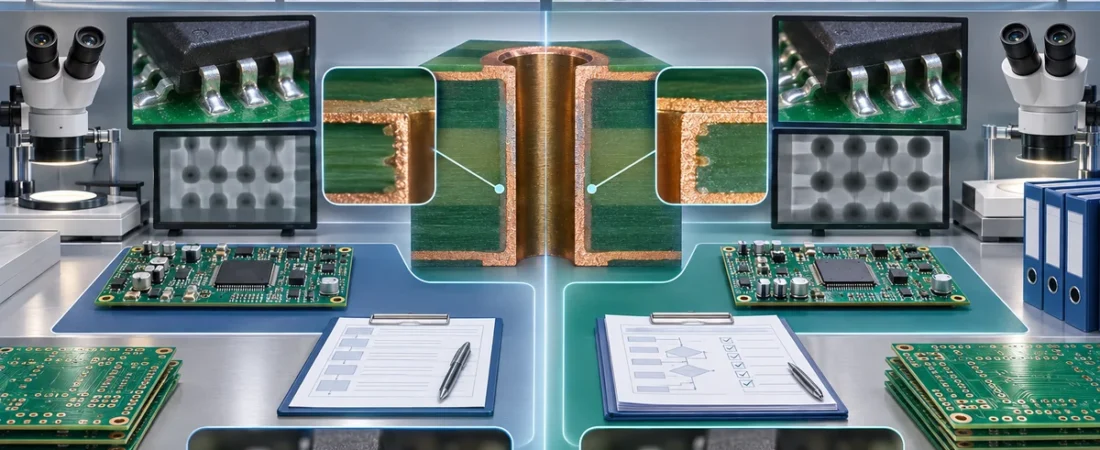
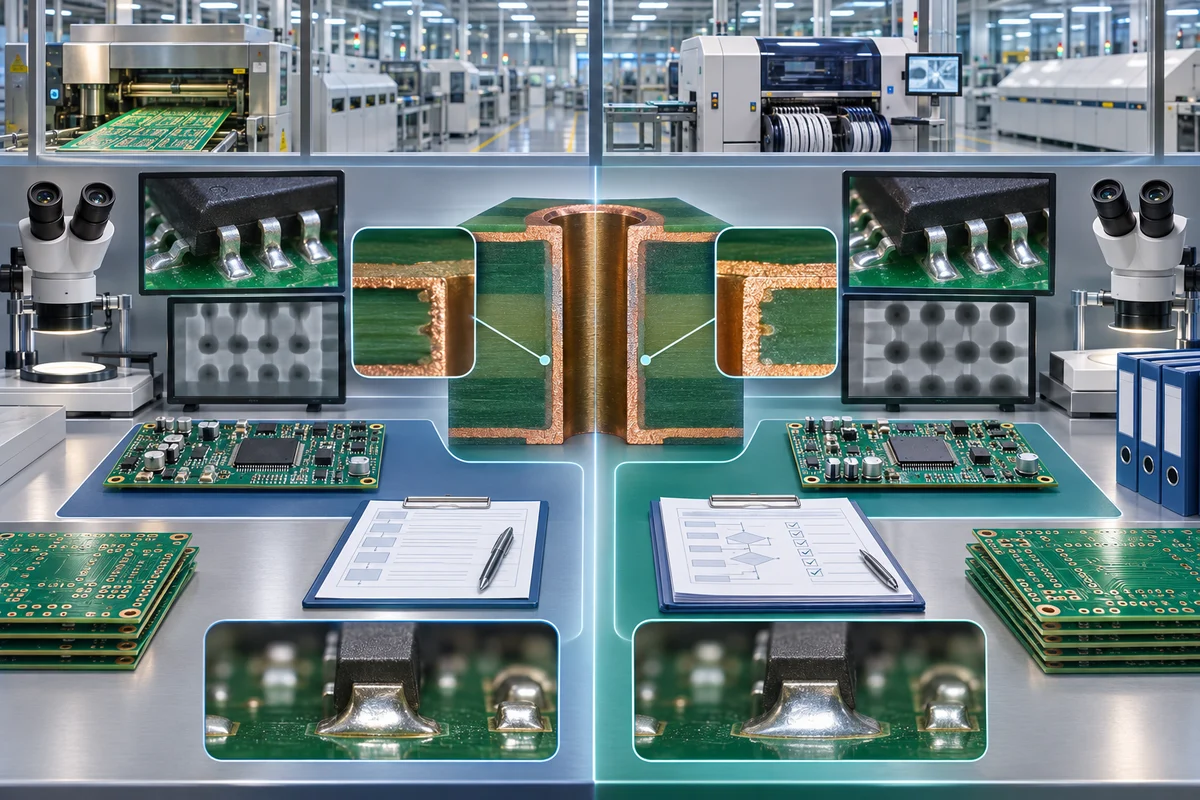
IPC Class 2 and Class 3 are not simple labels for “good” and “better.” They describe different performance expectations and acceptance requirements. Class 2 targets continued performance and extended life for dedicated-service products; Class 3 addresses high-performance products where continued operation is critical and downtime may be unacceptable.
The class must be specified in the purchase documents with the applicable standard and revision. A Class 3 assembly also depends on the bare board, design, materials and process evidence; a final visual inspection alone cannot create Class 3 quality.
1. Acceptance changes across the manufacturing chain
The practical difference reaches hole-wall quality, annular features, conductor defects, solder joints, cleanliness and workmanship. Exact criteria depend on the governing IPC document and revision.
| Area | Class 2 focus | Class 3 impact |
|---|---|---|
| Bare PCB | Reliable dedicated-service performance | Tighter acceptance and stronger evidence for high-performance use. |
| Assembly | Acceptable soldering and workmanship | More restrictive conditions for critical joints and features. |
| Design | Manufacturable product requirements | Greater margin, access and reliability planning. |
| Documentation | Normal lot records | More explicit traceability and objective evidence. |
2. Process control matters more than final sorting
Class 3 cannot be achieved economically by rejecting more boards at the end. The supplier needs capable processes, controlled materials, trained inspection and reaction plans.
| Control | Evidence to request | Business reason |
|---|---|---|
| PCB fabrication | Coupons, microsections, electrical test and lot traceability | Confirms the hidden structure. |
| Assembly | Profile records, first article, AOI/X-ray programme and workmanship records | Links acceptance to the process. |
| Materials | Approved laminate, finish, solder and storage controls | Prevents unapproved substitution. |
| Change control | Notice and approval for material/process changes | Protects qualification. |
3. Cost comes from risk reduction, not the class name
Cost can rise through tighter fabrication yield, additional coupons or sections, increased inspection, documentation, engineering review and lower throughput. The actual delta depends on design maturity and supplier capability.
| Cost driver | When it increases | How to control it |
|---|---|---|
| Board geometry | Small annular rings, dense vias, thin structures | Design with margin instead of relying on sorting. |
| Inspection | More samples or advanced imaging | Define risk-based scope. |
| Records | Customer-specific reports and retention | Use a standard evidence pack. |
| Supplier fit | Class 3 is outside routine capability | Qualify before price comparison. |
Specify the requirement precisely
A strong RFQ names the product class for PCB and PCBA separately, document revision, deviations, test and coupon requirements, acceptance sampling, records, retention and approval route. If only a few circuits are safety-critical, do not assume the whole product can be upgraded by a vague Class 3 note.
Frequently asked questions
Is Class 3 always more reliable?
It supports higher-reliability intent, but actual reliability still depends on design, materials, process capability and operating environment.
Can a Class 2 design be built as Class 3 without changes?
Sometimes, but not automatically. Geometry, access, materials and evidence may need revision.
Does Class 3 mean 100% inspection?
Not universally. Sampling and inspection scope must follow the applicable standard and purchase specification.
Technical references
- Global Electronics Association — IPC standards
- IPC-6012E table of contents
- IPC-A-610H table of contents
References checked 15 November 2026. Use the applicable purchased standard and revision; public summaries do not replace normative requirements.