
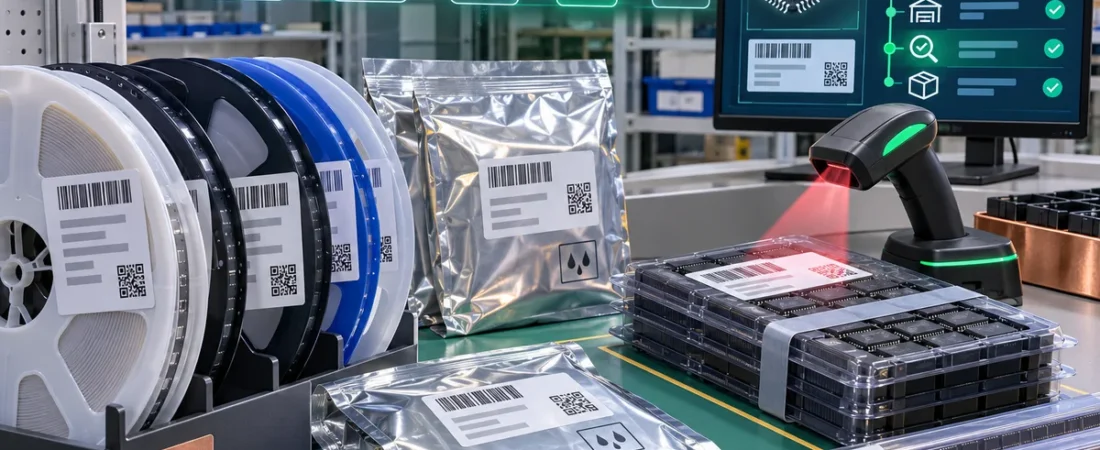
Traceability is the ability to connect a received component to its declared manufacturer, part number, lot or date code, supplier transaction and eventual production use. It does not automatically prove authenticity or quality, but it makes discrepancies, containment and failure analysis far more manageable.
The correct evidence package depends on risk. A commercial resistor bought through an authorized channel does not need the same file as an obsolete high-value IC from an independent source. Buyers should define evidence before the purchase order, not after a problem appears.
1. Define the identity that must remain linked
Record manufacturer name, exact manufacturer part number, package, quantity, lot/date code, country or site when available, and supplier lot. Do not substitute an internal SKU for the exact MPN. Mixed lots should be disclosed and separated.
2. Request evidence from the supply path
For authorized procurement, keep distributor invoice/packing list, manufacturer or distributor labels and a CoC when contractually required. For independent sourcing, request prior-supply-chain evidence where available, high-resolution label and part photos, packaging condition and a risk-based inspection/test plan.
| Evidence | What it supports | What it does not prove alone |
|---|---|---|
| Manufacturer/supplier label | Declared MPN, quantity and lot linkage | Authenticity or electrical performance. |
| Invoice / packing list | Commercial path and transaction | Condition of the individual parts. |
| CoC | Supplier’s conformity declaration | Independent laboratory verification. |
| Photos at receipt | Packaging and markings at a point in time | Internal die identity. |
| Test report | Results for stated method and sample | Untested units or other characteristics. |
3. Match documents to physical material
Receiving should compare label format, MPN, quantity, lot/date code, moisture barrier bag and seal condition. Capture discrepancies before relabeling or splitting reels. Document continuity matters more than a large stack of unrelated PDFs.
4. Scale testing to risk
Visual inspection, dimensions and marking review can reveal anomalies but cannot prove every internal condition. X-ray, XRF, solderability, decapsulation or electrical tests answer different questions. Define sampling, laboratory, method and acceptance criteria before testing.
5. Continue traceability through PCBA
Link incoming lot to material issue, feeder/reel, work order, assembly serial or batch, process records and any rework. This allows containment to the affected units instead of blocking all production.
6. Put evidence requirements in the PO
State accepted sources, lot mixing rules, shelf-life/MSL requirements, documents, photos, tests, record-retention period and change-notification obligations. JEXPCB can align sourcing and assembly records to the approved risk plan; buyers should confirm sector-specific requirements.
Release checklist
| Input | Confirm before order | Evidence |
|---|---|---|
| Revision | Files, drawing and BOM use the same revision. | Controlled package or checksum. |
| Technical assumptions | Material, stack-up, process and acceptance criteria are explicit. | Reviewed quotation / DFM record. |
| Traceability | Required lot, process and inspection records are defined. | Traveler, report or certificate. |
| Change control | Deviation and substitution need named approval. | Written approval before production. |
Frequently asked questions
Does a CoC prove authenticity?
No. It is one link in the evidence chain and must match the material.
Should buyers prohibit mixed date codes?
Only when product, qualification or containment needs justify it; otherwise require disclosure and separation.
Technical references
- IPC-1782 — Manufacturing and Supply Chain Traceability
- Global Electronics Association — IPC-1782A overview
- JEDEC — Standards and documents
References checked 5 November 2026. Evidence depth should be agreed by buyer and supplier according to risk and applicable contract requirements.