
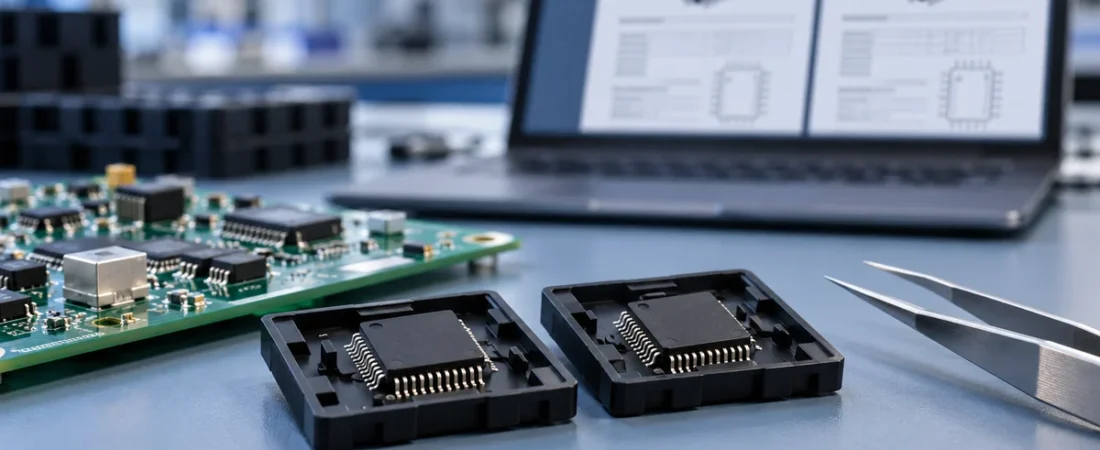
AI-generated editorial illustration of an electronic component comparison.
Electronic Components & Sourcing / Replacement approval
A shortage can turn one BOM line into a production decision. Purchasing finds a part with the same package and pinout, but engineering still needs to establish whether it will work in the actual circuit. A replacement that fits the board can change measurement timing, power dissipation or firmware behaviour. The useful question is: what evidence makes this alternative acceptable for this product?
The practical rule: treat a cross-reference result as a candidate. Approve the exact manufacturer part number against the application, document any conditions, and release it through a controlled BOM change before assembly.
1. Define what kind of alternative is allowed
A pin-compatible part has a compatible pin arrangement in the relevant package. That description alone does not establish electrical, thermal or software equivalence. A drop-in replacement should meet the requirements of the existing design without hardware or firmware changes; verify what the supplier means by that term. A functional alternative may perform the required task while needing a new footprint, supporting components or software.
State the boundary in the RFQ: exact parts only, approved alternates allowed, or new candidates welcome for engineering review. Identify who has approval authority. This prevents a sourcing suggestion from being mistaken for permission to build.
2. Compare the part against the application
Start with current manufacturer datasheets for both complete ordering codes, including package and grade suffixes. Compare guaranteed limits under relevant conditions. A similar headline value or a typical characteristic at room temperature is not enough evidence for operation across the product’s required range.
| Review area | What to check | Why it matters |
|---|---|---|
| Package and pins | Dimensions, pitch, pin functions, exposed pad, orientation and land pattern. | A matching package name can conceal footprint or connection differences. |
| Electrical operating limits | Supply and signal ranges, current, accuracy, leakage and required design margins. | The circuit must meet its specification over the agreed operating conditions. |
| Dynamic behaviour | Bandwidth, switching or conversion timing, startup and transient response. | Steady-state operation does not establish correct timing or stability. |
| Thermal performance | Operating grade, power dissipation and thermal guidance for the actual PCB. | Similar ratings do not prove the same temperature rise in the product. |
| Firmware and interfaces | Registers, reset defaults, device identification, addresses and data format. | The board may require different configuration or interpretation of results. |
| Passive components | Tolerance, dielectric, effective capacitance, ESR and application-specific ratings. | Nominal resistance or capacitance alone does not describe circuit behaviour. |
| Assembly and supply | Soldering guidance, moisture handling, packaging, lifecycle and documented source. | The approved part must also be suitable for production and repeat procurement. |
For example, Murata explains that high dielectric constant ceramic capacitors can lose effective capacitance under DC bias. Compare the actual part’s characteristics at the intended voltage rather than approving a substitute solely by the capacitance printed in the BOM. See Murata’s DC-bias explanation.
3. A real example of pin compatibility with different performance
Texas Instruments lists the ADS1115 as a pin-to-pin compatible alternative to the ADS1015, with higher resolution but a slower sample rate. The ADS1015 is a 12-bit ADC rated up to 3,300 samples per second; the ADS1115 is a 16-bit ADC rated up to 860 samples per second.
For a design needing faster acquisition, the higher-resolution device may fail the timing requirement. Engineering must review the exact package, conversion settings and software before approving it. This is a datasheet comparison, not a recommendation to exchange the parts in every circuit. See the manufacturer pages for ADS1015 and ADS1115.
4. Validate the candidate and record the decision
Make the differences visible
Prepare a comparison record showing the original and proposed manufacturer part numbers, affected reference designators, datasheet revisions, differences and unresolved questions. Record the proposed supply channel separately from technical compatibility. TI recommends buying its parts directly or through its authorized distributors to reduce counterfeit risk; technical similarity does not establish authenticity. Read TI’s sourcing guidance.
Agree a test plan before ordering production material
Choose validation according to the change and product risk. It may include schematic review, prototype measurements, firmware regression, startup and load tests, temperature checks or additional product qualification. Define the conditions and pass/fail limits before testing. A successful power-on check provides limited evidence; it does not cover every operating state.
Release an exact approval
Record the approver, date, product and board revision, test evidence, permitted part numbers and any restrictions. Mark whether approval covers a trial quantity, one order or ongoing production. Update the approved vendor or manufacturer list and BOM consistently. Preserve the actual parts and lots used in the build so later faults can be traced to a production configuration.
5. Compare the full cost of the change
Include engineering review, samples, qualification, firmware work, stencil or layout changes, and inventory consequences in the decision. A cheaper unit price can lose its advantage when validation or redesign is required. Conversely, a qualified alternative can improve supply flexibility for later orders. Compare these outcomes against the cost and schedule of waiting for the original part.
When requesting a quote, send a BOM with a separate status for each proposed alternative: candidate, under review or approved. Include required quantities, target dates and substitution restrictions. Our PCBA quotation file guide explains the wider build package.
Common questions
Can an equivalent-parts search approve a substitute?
It can help find candidates. The product owner still needs to review compatibility and authorize the change for the intended application.
Does a higher specification guarantee a better replacement?
No. One parameter can improve while another becomes unsuitable, as the ADC example shows. Evaluate the circuit requirements together.
Have a BOM with unavailable parts?
Share the original part numbers, quantities and approval restrictions with JEXPCB. See our component sourcing service and identify which alternatives still need your engineering review.
Request a QuoteTechnical sources checked 27 October 2026. Linked manufacturer specifications take precedence; the checklist is a review framework for the intended product.