
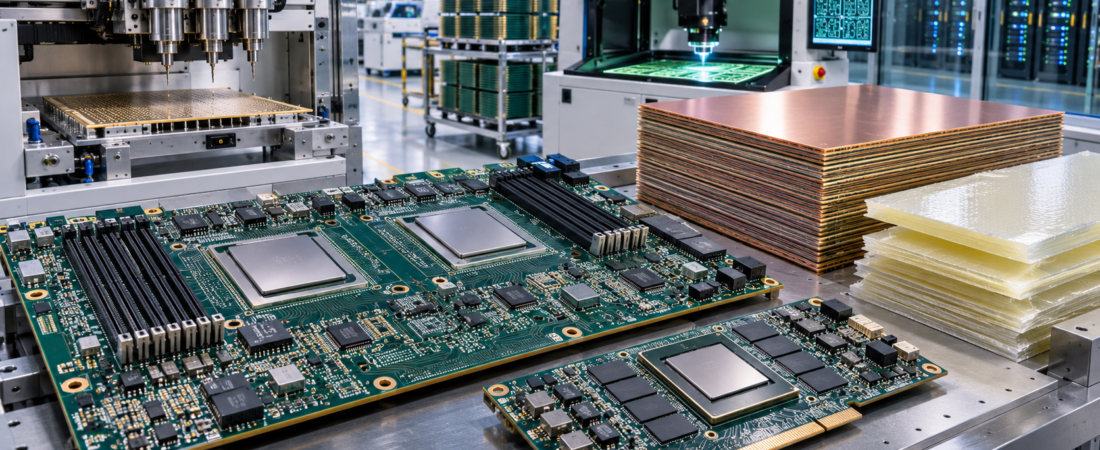
AI hardware demand is not creating one uniform PCB shortage. It is concentrating pressure on specific capabilities: high-layer-count and large-format boards, advanced HDI, low-loss laminates, tight impedance control, high-aspect-ratio drilling and plating, back drilling, advanced IC substrates, thermal solutions and the inspection capacity required to build them reliably.
For buyers of ordinary industrial or consumer PCBs, the effect may be indirect. The same supplier group, material family or capital equipment may be prioritized for higher-value AI and data-center programs. Lead times and quotations can therefore change even when the customer’s own design has nothing to do with an AI accelerator.
1. Why AI server boards consume a different capacity mix
AI servers combine high-speed communication, dense power delivery, large processors, high-bandwidth memory interfaces and extensive networking. PCB suppliers are responding with larger and thicker boards, higher layer counts, HDI structures and stricter signal-integrity requirements. Zhen Ding has described growing demand for high-layer-count and HDI PCBs for AI servers, while TTM’s 2025 annual report identified generative-AI data-center demand as a major growth driver.
| AI hardware requirement | PCB / material impact | Capacity consumed |
|---|---|---|
| High data rate | Low-loss laminate, controlled weave, smooth copper, tighter impedance and insertion-loss control. | Qualified material allocation, signal-integrity engineering, test and coupon capacity. |
| Dense interconnect | Higher layer count, sequential lamination, microvias, fine lines and advanced registration. | Lamination cycles, laser drilling, imaging, plating and yield-learning time. |
| Large board size | Greater dimensional and thermal-management challenge with lower panel utilization. | Large-format tooling, presses, inspection field and material area per finished board. |
| High current and heat | Heavy copper features, dense power planes, copper coins or other thermal structures. | Specialized plating, lamination, machining and thermal verification. |
| Expensive components | Stricter defect prevention, traceability, X-ray, test and repair planning. | Advanced inspection, electrical test, reliability and controlled rework resources. |
2. The bottleneck can move upstream into materials
Low-loss copper-clad laminate is not interchangeable with standard FR-4. Resin system, glass style, copper profile, thickness availability and supplier qualification all affect signal performance and manufacturing behavior. AI and high-speed networking demand is therefore increasing attention on high-performance CCL, prepreg, low-profile copper foil and specialized glass cloth.
Material suppliers are expanding, but new lines do not appear instantly. Panasonic Industry announced investments to expand MEGTRON production for AI servers, with additional capacity coming in phases. Elite Material has also disclosed multi-site expansion for high-speed CCL. AGC noted tight glass-cloth supply in its 2026 semiconductor-related business briefing. These are signals of investment and constraint in selected high-end categories—not proof that every laminate grade is unavailable.
3. Expansion announcements do not immediately remove lead-time risk
PCB and substrate producers are adding capacity. AT&S announced expansion for high-end AI substrates, TTM added advanced PCB manufacturing capability, and Zhen Ding disclosed major investment in high-end PCB capacity. However, construction, installation, process qualification, customer validation and yield ramp all take time. Capacity also may be committed to strategic programs before it becomes visible to the wider market.
For sourcing decisions, separate existing qualified capacity from announced future capacity. A press release is not a confirmed delivery slot. Ask which site, line, material and process is qualified today, what is allocated, and which assumptions support the quoted lead time.
4. Why non-AI projects can still feel the effect
| Transmission channel | Possible buyer impact | What to verify |
|---|---|---|
| Shared material supplier | Allocation, longer replenishment or changes to minimum purchase quantity. | Exact manufacturer, grade, thickness, copper and approved alternatives. |
| Shared high-end equipment | Longer queues for laser drill, sequential lamination, back drill or advanced test. | Which process step is on the critical path and its current loading. |
| Supplier product mix | Factories may prioritize qualified strategic programs and higher-complexity work. | Allocated slot, order priority, factory site and firm schedule conditions. |
| Raw-material price revision | Quote validity shortens or material surcharges appear. | Cost driver, effective date, validity and whether material is locked after PO. |
| Engineering attention | Slower stack-up review, impedance modeling, CAM or qualification response. | Named engineering owner and date for technical closure. |
5. Do not solve a material shortage with an uncontrolled substitution
A supplier may propose a “same grade” or “equivalent” laminate to protect delivery. The change can affect dielectric constant, dissipation factor, glass style, resin content, copper roughness, Z-axis expansion, CAF behavior, thermal performance, drill quality, lamination and impedance. For high-speed designs, insertion loss and skew may be more important than the nominal Tg.
Define approved manufacturer and grade options in advance. Require a revised stack-up and impedance calculation for any change, and determine whether signal-integrity simulation, coupons, microsection, thermal testing or customer approval is necessary. A purchasing substitution should never bypass design authority.
6. Separate quoted lead time into controllable stages
“PCB lead time” can contain material procurement, engineering review, CAM, tooling, coupon setup, fabrication, electrical test, reliability verification and logistics. Ask the supplier to identify the critical path. If the constraint is material, an approved alternate or forecast reservation may help. If the constraint is sequential lamination or back drilling, paying for faster transport will not solve it.
Prototype and mass-production lead times also behave differently. A factory may fit a small lot into an engineering queue but lack a confirmed volume slot. Conversely, a strategic volume program may receive allocation while engineering samples wait for specialized setup.
7. Use a risk-based sourcing response
| Action | When it helps | Control required |
|---|---|---|
| Earlier forecast visibility | Material or production slots need advance planning. | Separate forecast from firm order and define reservation terms. |
| Approved material matrix | Several technically valid laminate sources can support the design. | Design, stack-up, SI and customer approval before release. |
| Capacity reservation | Stable repeat demand justifies committed slots or material. | Volume, cancellation, liability, validity and rescheduling terms. |
| Second-source qualification | Single-site or single-supplier exposure is unacceptable. | Equivalent process capability, test correlation and controlled revision. |
| Design simplification | A requirement forces rare material or heavily constrained processing without sufficient value. | Engineering validation; never trade away performance or reliability blindly. |
8. What a defensible supplier quote should disclose
For complex boards, request the manufacturing site, stack-up revision, named laminate system, copper type, impedance assumptions, sequential lamination count, via structure, back-drill requirement, test method, material lead time, fabrication lead time, quote validity and any allocation condition. Ask which items are firm and which remain subject to engineering review.
Do not compare only the final unit price. A low quote based on an unapproved material, optimistic yield or unconfirmed capacity can become the most expensive option after redesign, requalification or schedule failure.
9. A practical JEXPCB capacity-risk workflow
Provide controlled Gerber or ODB++ data, stack-up, impedance table, material restrictions, annual volume, ramp plan, prototype need date and mass-production horizon. Identify the parameters that cannot change and those that may be optimized.
JEXPCB can coordinate stack-up review, material availability checks, DFM, quotation comparison, sample build and production planning through its PCB manufacturing network and qualified partners. Capacity and lead-time statements remain project-, site- and date-specific; they should be reconfirmed when an order is released. Submit the controlled package through the PCB manufacturing quotation page.
Frequently asked questions
Is AI demand making all PCBs more expensive?
No. The effect is uneven. High-end materials and processes can face stronger pressure, while standard technology may have different utilization and pricing. Evaluate the exact stack-up, site and process rather than using a market-wide assumption.
Does announced new capacity mean lead times will fall immediately?
No. New plants and lines require construction, equipment installation, qualification, customer approval and yield ramp. Some capacity may also be committed before volume production begins.
Can a different low-loss laminate be treated as a drop-in replacement?
Not automatically. Dk, Df, glass style, copper profile, resin behavior and thickness availability can change impedance, loss, skew and manufacturability. Engineering approval is required.
Should buyers reserve capacity for every project?
No. Reservation is most useful for stable repeat demand with a genuine constrained process or material. The commercial liability and forecast accuracy must justify the commitment.
Technical and market references
- TTM Technologies — 2025 Form 10-K
- Zhen Ding Technology — 2025 Annual Report
- AT&S — 2026 AI substrate capacity expansion
- Panasonic Industry — 2026 circuit-board material price revision
- Panasonic Industry — 2026 investment in AI-related materials capacity
- AGC — 2026 Semiconductor-related Business Briefing
Sources checked 5 November 2026. Company statements and forecasts are not guarantees of future market conditions; project quotations should be reconfirmed at order release.