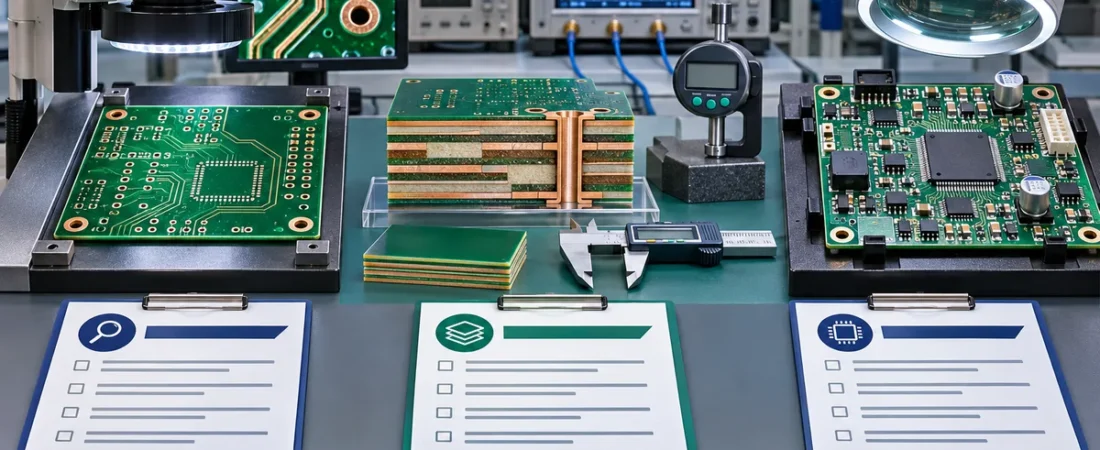
IPC-A-600, IPC-6012 and IPC-A-610 are often listed together on RFQs, but they do not inspect the same product or serve the same purpose. IPC-6012 is a qualification and performance specification for rigid printed boards. IPC-A-600 illustrates acceptable and nonconforming conditions on bare printed boards. IPC-A-610 addresses acceptability of completed electronic assemblies.
Using the wrong document can leave a real requirement undefined. A statement such as “IPC Class 2” should identify the product, document, revision, applicable class and any customer-specific exceptions.
1. IPC-6012 sets rigid-board performance requirements
It covers qualification and performance expectations for rigid printed boards, including product classes and requirements that can involve materials, conductor features, holes, plating, cleanliness, electrical test and coupons. It is a procurement specification, not a photo atlas.
2. IPC-A-600 supports acceptance of the bare board
It provides visual representations and explanatory criteria for external and internal conditions of printed boards. Inspectors use it to interpret conditions such as conductor anomalies, holes, plating and laminate features, typically in conjunction with the applicable performance specification.
3. IPC-A-610 starts after assembly
It is the widely used acceptability standard for electronic assemblies. It addresses component installation, solder connections, terminals, cleanliness-related visible conditions and other workmanship features on the populated assembly. It does not define how the bare PCB was fabricated.
| Document | Primary object | Main purpose | Does not replace |
|---|---|---|---|
| IPC-6012 | Rigid bare printed board | Qualification and performance requirements | Drawing, customer specification or assembly criteria. |
| IPC-A-600 | Bare printed board | Illustrated acceptability conditions | Applicable performance specification or electrical test. |
| IPC-A-610 | Completed electronic assembly | Assembly acceptability/workmanship | Bare-board fabrication specification or process control. |
4. Product classes express different end-use expectations
Classes are not simply “good, better, best.” The customer selects the class appropriate to service environment and performance requirements. A class choice affects acceptance limits and evidence; it does not remove the need for drawings and customer-specific requirements.
5. Write a complete purchase requirement
State the exact document and revision, class, applicable addendum, drawing hierarchy, coupons/tests, certificates, sampling and deviation approval route. For PCBA, separate bare-board fabrication requirements from assembly requirements and include J-STD-001 when soldering process requirements are contractually needed.
6. Resolve conflicts before production
If drawing, customer specification and IPC documents conflict, the contract must define precedence. JEXPCB can coordinate PCB and PCBA DFM review, but the buyer should approve the governing revision and any exception before manufacturing.
Release checklist
| Input | Confirm before order | Evidence |
|---|---|---|
| Revision | Files, drawing and BOM use the same revision. | Controlled package or checksum. |
| Technical assumptions | Material, stack-up, process and acceptance criteria are explicit. | Reviewed quotation / DFM record. |
| Traceability | Required lot, process and inspection records are defined. | Traveler, report or certificate. |
| Change control | Deviation and substitution need named approval. | Written approval before production. |
Frequently asked questions
Is “IPC Class 2” enough on an RFQ?
No. Name the document, revision, product and exceptions.
Does IPC-A-610 certify the PCB fabricator?
No. It is an assembly acceptability document, not a fabricator certification.
Technical references
- Global Electronics Association — IPC Standards
- IPC — Introduction to IPC-A-610 syllabus
- IPC-A-610 — Acceptability of Electronic Assemblies
References checked 5 November 2026. Always verify the contractually required revision and applicable addenda before release.