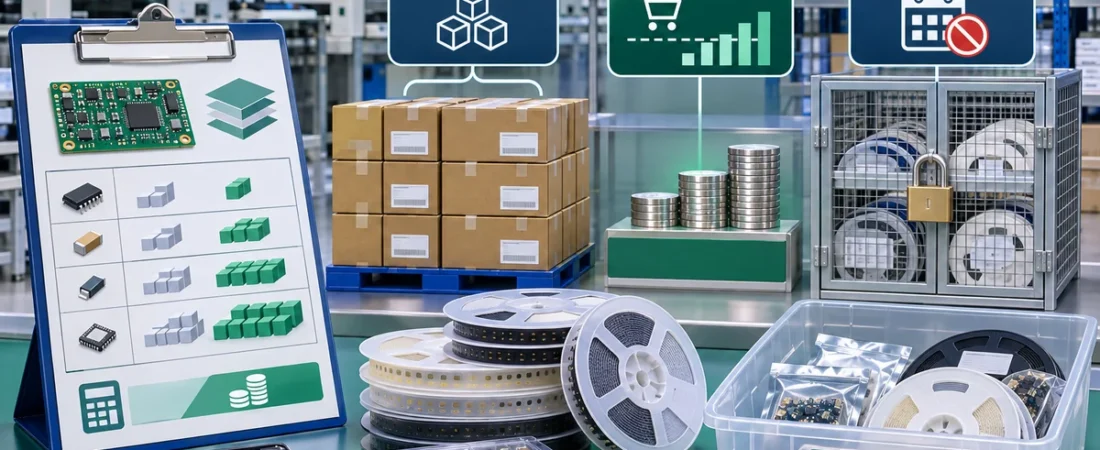

A turnkey PCBA quote can look competitive while transferring substantial material risk to the buyer. Minimum order quantity (MOQ), minimum order value (MOV), non-cancellable non-returnable (NCNR) commitments and supplier pack sizes may force a purchase above the immediate build requirement.
These terms are not interchangeable. They also vary by distributor, manufacturer, part and market condition. A useful quote therefore separates the quantity consumed by the order from the quantity that must be purchased and clearly assigns ownership of the balance.
1. Separate the four commercial constraints
MOQ controls the smallest quantity that can be ordered, while MOV controls the minimum monetary value. NCNR limits cancellation or return rights. Standard pack or reel size may create additional excess even when no formal MOQ is stated.
| Term | What it controls | Typical buyer exposure |
|---|---|---|
| MOQ | Minimum pieces per order | Unused components remain after the build. |
| MOV | Minimum line or order value | Low-cost items may be purchased far above demand. |
| NCNR | Cancellation and return rights | Demand changes do not remove the payment obligation. |
| Pack size | Tray, tube, reel or factory pack | Purchasing rounds up to a packaging multiple. |
2. Read the quotation as a material-flow model
Two suppliers can quote the same assembly quantity but use different assumptions. One may amortize excess into the unit price; another may show it as a separate liability; a third may retain stock for future releases.
| Quotation field | Minimum information | Why it matters |
|---|---|---|
| Required for build | BOM quantity plus agreed attrition | Shows actual consumption. |
| Purchase quantity | Order multiple and supplier source | Shows cash committed. |
| Excess disposition | Hold, return, transfer or scrap | Defines control of unused material. |
| Price validity | Date and allocation basis | Prevents an expired price from appearing firm. |
3. Define ownership and release rules
Leftover material is not automatically customer-owned simply because it influenced the quote. The contract should define title, storage period, traceability, future-use authorization, audit evidence and disposition.
| Decision | Recommended wording focus | Risk if omitted |
|---|---|---|
| Ownership | When title transfers and whether the stock is segregated | The same inventory may be allocated elsewhere. |
| Storage | MSL, shelf life, ESD and date-code controls | Material can lose usability while waiting. |
| Future release | Part number, revision and consumption priority | Old stock may not fit a changed BOM. |
| Close-out | Return, transfer, approved scrap and charges | Projects end with unresolved inventory. |
Build a commercial material-liability schedule
For each constrained item, list manufacturer part number, approved source, demand, attrition, buy multiple, purchase quantity, unit cost, NCNR status and excess disposition. Procurement can then compare total committed cash rather than a deceptively low PCBA unit price.
Frequently asked questions
Is NCNR always unreasonable?
No. It can be appropriate for custom, allocated or specially purchased material, but it must be explicit and limited to the actual commitment.
Who should own leftover components?
The contract decides. If the customer funds them, require clear identification, traceability and a release or return mechanism.
Can excess be reused on the next order?
Only if the part, revision, shelf life, storage history and demand remain valid.
Commercial references
- DigiKey — Terms and conditions
- Mouser Electronics — Terms and conditions
- Arrow Electronics — Terms and conditions
Terms checked 15 November 2026. Supplier conditions differ; the signed quotation and purchase contract remain controlling.