
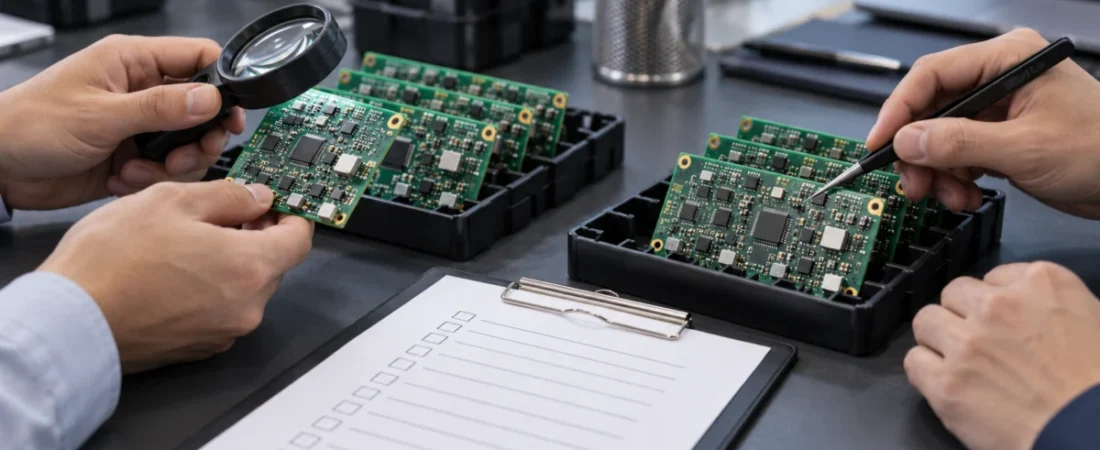
AI-generated editorial illustration of two PCB assembly sample lots under supplier-qualification review.
A second quotation is not the same as a qualified second source. When a disruption occurs, the new supplier still has to interpret the data package, confirm materials and processes, resolve DFM questions, build samples, meet acceptance criteria and become commercially ready. If the product cannot wait through that work, qualification has started too late.
At the same time, dual sourcing is not automatically justified for every prototype or low-risk board. Qualification consumes engineering time, samples, fixtures, audit effort and change control. The decision should follow business impact and technical transfer risk rather than a blanket rule.
When should qualification start?
| Trigger | Why it matters for PCB/PCBA | Practical response |
|---|---|---|
| Single supplier plus high interruption cost | A tooling, capacity, quality or logistics issue can stop the product | Qualify before the current source becomes unstable |
| Rapid volume growth or seasonal peaks | Prototype capacity and series capacity are not necessarily the same | Run a pilot at the expected technology and panel/assembly scale |
| Long-life or service obligation | Materials, components and process knowledge must remain available | Validate a transferable specification and lifecycle controls early |
| Concentrated geography or logistics route | One regional or transport event can affect all supply | Evaluate a genuinely independent route, not only a different sales office |
| Special material, finish, HDI, impedance or assembly process | A nominally similar supplier may not reproduce the construction | Confirm process evidence and build representative samples |
| Repeated delivery, quality or communication drift | Trend deterioration can precede a serious interruption | Start qualification while the primary source still supports production |
| New market, compliance or customer requirement | Documentation, traceability or approved-site rules may change | Include the requirement in screening and sample acceptance |
NIST’s Manufacturing Extension Partnership recommends supply-chain mapping and risk assessment, including identifying secondary or alternative suppliers and using supplier metrics or scorecards. The important word is assessment: a backup source should address the failure mode that concerns you. Two suppliers dependent on the same constrained material, sub-tier or transport lane may not provide meaningful independence.
Define what “qualified” means
Qualification is better treated as a set of readiness levels than a yes/no label:
| Readiness level | Evidence | What it enables |
|---|---|---|
| File-ready | Controlled, complete fabrication/assembly package and access rights | A supplier can review the correct revision without reconstructing requirements |
| Engineering-screened | Capability review, DFM response, proposed stackup/process and risk exceptions | Confirms the design is plausibly transferable |
| Sample-qualified | First articles built to frozen data and accepted against a defined plan | Provides technical evidence from real hardware |
| Production-ready | Pilot yield, test flow, sourcing plan, quality records, commercial and logistics terms approved | Supports a controlled production order |
| Maintained backup | Periodic data review or repeat build, change notifications and current contacts | Reduces the risk that an old approval becomes obsolete |
A supplier that passed a sample five years and several revisions ago may no longer be production-ready. Record the product revision, site, materials, processes, test program and scope covered by the approval.
1. Start with a risk and scope statement
Identify the interruption you are trying to reduce and the maximum tolerable recovery time. Decide whether the alternate scope is bare-PCB fabrication, component sourcing, assembly, test, box build or the complete chain. A second PCB fabricator does not solve a sole-source component or proprietary functional-test fixture; a second assembler may still depend on the same PCB plant.
Prioritize products by revenue exposure, field-service obligation, safety or regulatory impact, forecast volatility, technical complexity and replacement lead time. A simple low-volume board with months of finished stock may warrant only a file-ready option. A high-impact PCBA with custom material and programmed components may justify a maintained production-ready source.
2. Build a transferable technical package
The transfer package is the core of qualification. For PCB fabrication it normally includes controlled Gerber or ODB++ data, drill files, stackup, finished copper, material and surface-finish requirements, impedance table, tolerances, panel or routing constraints, acceptance criteria and revision history. For PCBA, add the BOM with approved manufacturer part numbers, placement data, drawings, polarity and special-process notes, firmware/programming files, test procedures, fixtures and packaging requirements.
Separate requirements from the incumbent supplier’s undocumented habits. If a construction, substitution, inspection method or deviation is essential, put it in controlled documentation. The IPC checklist for producing rigid printed board assemblies illustrates how many choices—from base material and surface finish to soldering, cleaning and acceptability—sit at the CAD-to-manufacturing interface.
3. Screen capability with project-relevant evidence
Ask for evidence tied to the actual board: layer structure, feature sizes, material family, controlled impedance, via technology, finish, component packages, soldering processes, inspection, test and required records. A long generic capability list is less useful than a written review of your files and the proposed process flow.
Evaluate the specific manufacturing site, not only the corporate brand. Clarify which operations are internal or subcontracted, how changes are approved, how materials and components are traced, and which quality-system or customer requirements genuinely apply. Do not demand unrelated certifications simply as a proxy for technical fit.
4. Compare engineering outputs before samples
Review the alternate supplier’s DFM questions, stackup, impedance geometry, panelization, stencil or assembly recommendations, component exceptions and test proposal. Resolve every approved deviation against the product owner’s change process. The goal is equivalent controlled output, not necessarily an identical factory recipe.
For PCBA, confirm the approved vendor list, substitution authority, moisture-sensitive handling, programming ownership, test access, golden units and fixture duplication. A functional fixture located only at the incumbent can remain a single point of failure even when the assembly line is qualified.
5. Qualify representative hardware
Build first articles from a frozen revision using the intended material and process route. The acceptance plan may include document review, dimensional and visual inspection, microsection or impedance evidence, electrical test, component traceability, AOI/X-ray/ICT records, functional test and product-specific reliability work. Not every test applies to every product; select them from risk and customer requirements.
A tiny hand-built sample may not expose panel utilization, solder-paste transfer, automated test time or production yield. Where business impact is high, follow the first article with a pilot that represents the planned process and quantity. Capture defects, yield, rework, test escapes, lead time and communication quality.
6. Complete commercial and logistics readiness
Compare total transfer cost, not only unit price: tooling, test fixtures, programming, non-recurring engineering, minimum order, material buy, component liability, freight, duties, payment terms, packaging, buffer stock and change-control effort. Confirm realistic lead time from approved files and material release, plus how expedite requests and forecast changes are handled.
Decide in advance what event activates the backup, who may place the order, which quality gates remain mandatory and whether the primary source must be informed. Emergency purchasing without a release rule can create revision or counterfeit-component risk.
7. Keep the qualification current
A backup can go cold. Send approved revisions and change notices, maintain contacts and commercial terms, and periodically review critical materials, fixtures and test software. Depending on risk, place a controlled repeat order or run a readiness review. If the product, site, material or process changes materially, define what requalification is required.
Supplier qualification scorecard
- Technical fit: design review quality, process match, exceptions and testability.
- Quality evidence: acceptance results, traceability, corrective-action discipline and record control.
- Delivery resilience: capacity, material plan, sub-tier exposure and logistics alternatives.
- Commercial readiness: complete cost, terms, liability and activation lead time.
- Communication: response quality, escalation route, engineering ownership and change notification.
Weight the scorecard by product risk rather than averaging every field equally. A low price cannot offset an unmet safety or technology requirement.
Frequently asked questions
Do we need two suppliers for every PCB?
No. Compare interruption impact with the qualification and maintenance cost. Some low-risk or short-life designs are better protected by stock, transferable files or a rapid requalification plan.
Is an approved first article enough?
It proves only the defined sample scope. Production readiness may also require representative volume, test throughput, sourcing, logistics, quality records and commercial approval.
Must both suppliers use the identical stackup?
Not always. Electrical, mechanical and qualification requirements must be met, but equivalent materials or process details may differ if the design authority reviews and approves them.
How often should a backup source be reviewed?
Set a risk-based interval and trigger reviews after design, site, material, process, fixture or regulatory changes. There is no universal calendar that fits every product.
Qualify before the recovery clock starts
Prepare a controlled data package and define the evidence needed for sample and production release. JEXPCB can review PCB, sourcing and PCBA requirements for a prospective build; the buyer should retain final qualification, change-control and activation authority.
PCB quotation file checklist · PCBA quotation file checklist · Request a quote
Technical references
- NIST Manufacturing Extension Partnership: Supply Chain Management
- IPC: Checklist for Producing Rigid Printed Board Assemblies
Technical references checked 27 October 2026.