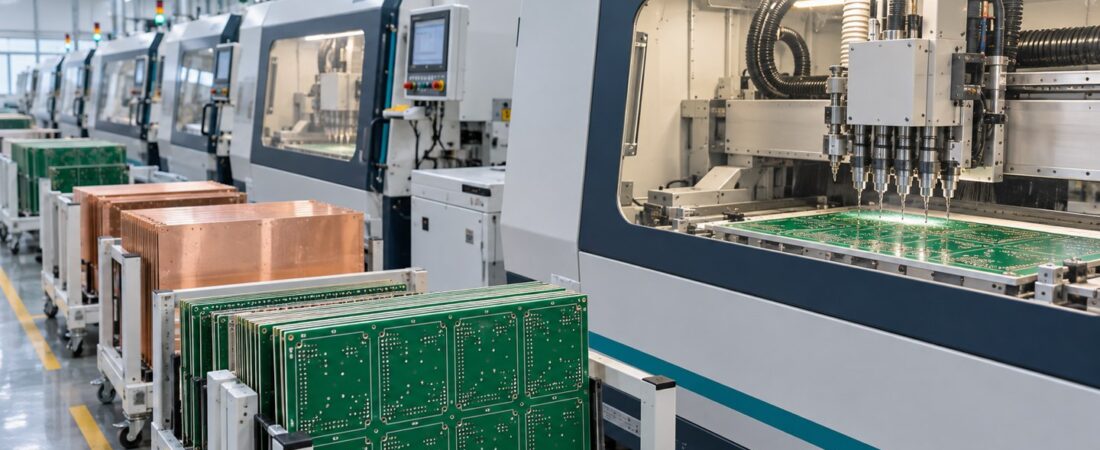
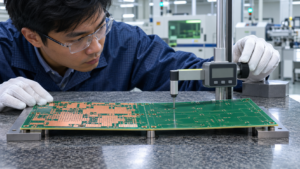
AI-generated production illustration
PCB Manufacturing / Engineering decision guide
Choose a PCB surface finish around pad geometry, assembly requirements, product use and the quotation specification. ENIG offers a planar nickel/gold finish; HASL applies a solder coating whose thickness can vary across pads. The right choice depends on the complete design and manufacturing process.
Give fine-pitch placement and coplanarity requirements early attention. For less demanding pad geometries, ask whether lead-free HASL meets the assembly needs and offers a useful cost advantage. Confirm the finish in the fabrication notes and quotation.
1. What ENIG and HASL do
A surface finish protects exposed copper pads against oxidation and contamination before soldering or electrical contact. It is separate from the green solder mask that covers other areas of the board.
ENIG means electroless nickel/immersion gold. Nickel forms the layer beneath a thin immersion-gold coating. The process produces a relatively flat surface, which is useful when pad coplanarity matters. It requires appropriate process control and an agreed acceptance specification.
HASL means hot air solder levelling. The PCB is coated with molten solder and excess material is removed with hot air. HASL can refer to leaded or lead-free processes: the alloy and lead-free requirement must be stated explicitly.
2. Compare the trade-offs
| Decision factor | ENIG | HASL |
|---|---|---|
| Surface geometry | Relatively planar nickel/gold finish. | Solder coating can vary in height across pads. |
| Fine-pitch assembly | Often considered when coplanarity and paste deposition are important. | Suitability should be reviewed against pad size, pitch and assembly process. |
| Cost | Usually a higher-cost option; actual pricing depends on the fabrication job. | Often an economical option where it meets the product requirements. |
| Fabrication considerations | Control the nickel/gold process and acceptance requirements. | Account for solder coating geometry and thermal exposure during the HASL process. |
| Lead-free requirement | Confirm the specified process and the complete product compliance requirements. | Explicitly request lead-free HASL where required; “HASL” alone is not enough. |
| Special contact use | Do not equate ENIG with electroplated hard gold. | Review any repeated-mating or contact-surface requirement separately. |
Neither finish should be selected from a single rule such as “gold is always better” or “all BGA boards need the same finish.” Package geometry, stencil and soldering processes, storage and the intended operating environment must be considered together.
3. Use four questions to make the decision
- What does the assembly require? Identify the smallest pads, fine-pitch packages and any coplanarity-sensitive areas. Review their requirements with the assembler and fabricator.
- How will the board be processed? State the soldering sequence, any rework expectations and relevant laminate or hole-geometry constraints. A finish is one part of the process plan.
- Are there special contact requirements? Edge connectors with repeated mating may need a dedicated hard-gold specification. Bonding, contact wear and other special applications require their own engineering review.
- What is the purchasing priority? Compare quotations using the same acceptance requirements and lead-free specification. Request a cost comparison rather than assuming a fixed percentage difference.
Storage life also depends on the finish specification, handling, packaging and environment. Ask for the supplier’s storage and solderability guidance instead of applying one universal shelf-life number to every board.
4. Put the decision into the quotation package
Identify ENIG or the requested HASL process in the fabrication drawing or order notes. Include board quantity, revision, material, thickness, copper weight and any stack-up requirements. Add relevant assembly or contact constraints, the required acceptance standard and revision, and any requested inspection documentation.
If the choice is unresolved, send the Gerber package and describe the critical packages or contact areas. Ask the supplier to review the options before the production files are approved. A surface finish alone does not establish compliance for an entire assembled product.
Explore PCB fabrication and PCB assembly to connect the board specification with the complete build.
- Eurocircuits — Surface-finish selection and process considerations
- Eurocircuits — Finish options and design context
- NCAB Group — Surface finish and cost/design trade-offs
References checked 25 October 2026. This guide is a selection aid, not a qualification standard or a claim about JEXPCB’s process limits. Final requirements belong in the agreed fabrication specification.
Discuss the finish with the build in mind.
Share the current board files and the assembly or contact requirements that matter to your product.
Request a QuoteRelated Articles
HDI Microvias: Stacked vs Staggered Vias and Sequential Lamination
A practical HDI guide to stacked and staggered microvias, sequential lamination, reliability trade-offs and production-release data.
PCB Backdrilling: When Via Stubs Become a Signal-Integrity Risk
A practical engineering guide to via-stub risk, backdrill decisions, manufacturing tolerances and inspection evidence for high-speed PCBs.
PCB Copper Balance: How Uneven Copper Causes Bow, Twist and Assembly Problems
Uneven copper distribution can drive PCB bow, twist, plating variation and assembly instability. Learn what to review before fabrication release.